|
|
Leiden
|

|

|
|
|
Leiden
is situated in the western part of the Netherlands near
the sea. Stately mansions, pretty canals and 35 almshouse
courtyards; they all tell about Leiden’s rich history.
This is Rembrandt’s native city, the city where Clusius
cultivated the first Dutch tulip, and where Boerhaave
taught. Leiden has 12 museums. Mummies await you in the
Rijksmuseum van Oudheden (national museum of antiquities),
paintings by Rembrandt and Jan Steen can be seen in the
Lakenhal, treasures from other cultures have been collected
in the Rijksmuseum voor Volkenkunde (national museum of
cultural anthropology), and surprising discoveries from
natural history are exhibited in Naturalis.
It is nice to go shopping in the historic city centre.
For nine centuries, the goods market has taken place along
the canals every Wednesday and Saturday. The connoisseur
is spoiled for choice; the large number of restaurants
has something for everyone.


University Town
The almost 15,000 students and 5,000 staff of the University
make Leiden a very lively and entertaining place and a
true student town.
Leiden has splendid bookstores and a wide range of delightful
cafes and restaurants, with and without sun terraces.
They offer many kinds of food ranging from French, Italian
or Spanish to Japanese, Thai, Indian, Surinamese, Chinese
or South American.
Culture
Leiden also offers a varied cultural life with many places
to listen to international music or to watch dance and
theatre performances. Leiden
is also a museum city; in addition to other museums, it
has five national museums including the National Museum
of Antiquities, the extremely modern National Museum for
Natural History (Naturalis), and the National Museum of
Ethnology. There are twelve museums in total, and
a university botanical gardens.
Rembrandt
van Rijn
Rembrandt was born and raised in Leiden. He was enrolled
at the University as a liberal arts student, but only
for a short while. He spent little time studying; he was
only truly interested in drawing and painting. The Lakenhal
Municipal Museum exhibits works by Leiden painters such
as Rembrandt, Lucas van Leyden and Jan Steen.
Location
Leiden
is conveniently located in the political, cultural and
economic heart of the Netherlands, which has an excellent
public transportation system. The train can bring you
to cities like Amsterdam, Rotterdam and Utrecht within
forty minutes, and it is just a short 10-minutes ride
to The Hague, the governmental center of the Netherlands
where the International Court of Justice is also located.
Throughout the week, these cities may also be reached
by night trains. From Leiden there are frequent and direct
trains to Schiphol Airport, which take only twenty minutes.
The area immediately around
Leiden also offers a wide range of recreational possibilities.
The North Sea, with its scenic beaches and sand dunes,
is only eight miles to the west of Leiden, and easily
accessible by bus. The more ambitious can cycle there
in about an hour. Behind the dunes are holiday resorts,
which bustle with life during the summer. To the north-east
of Leiden there are large lakes, excellent for sailing,
windsurfing, rowing and sometimes, when it is cold enough,
for ice-skating. The western part of the country lies
below sea level and an ingenious system of turbines, dikes
and canals keeps the feet of the Dutch dry.
Description
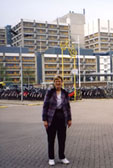
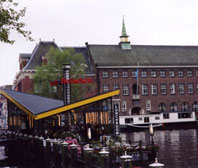
of Photos Above: Left:
Peter de Jong (Local Host Committee) and
Suzanne Stensaas (Head of Organizing Committee)
on the Leiden University Medical
Center Campus; Middle: Suzanne Stensaas in front of the
Leiden University Medical Center;
Right: Historic Building in Leiden's Town Center.
Tourist Office City Walk and More
More information
about the city of Leiden and its history can be found
on the homepage of Leiden tourist office (address): Gateway
to Leiden.
Leiden
City Map
The following links are a selection of the information
offered on the homepage of Leiden tourist office:
*Photos
provided by Caroline Raat.
top
|